
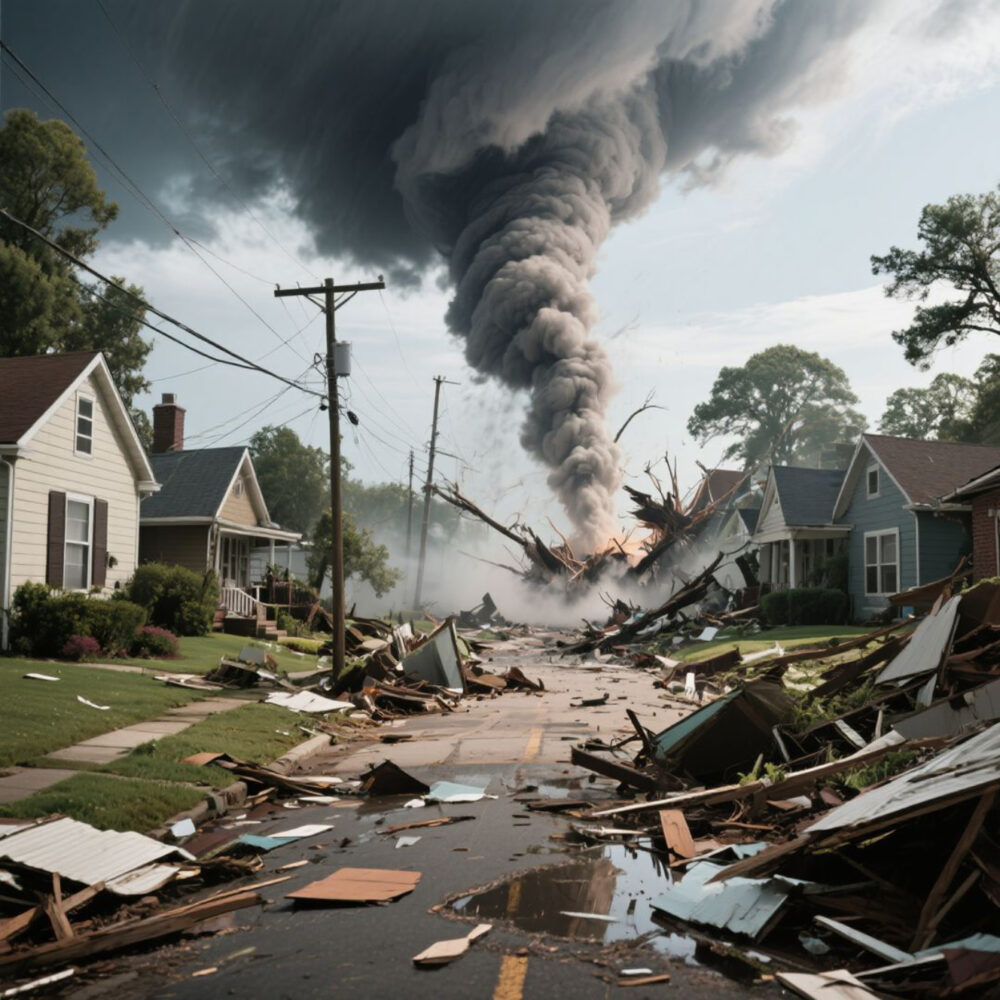
The Sooner State sits at the heart of Tornado Alley, one of the most meteorologically volatile regions on Earth. Tornado Alley is a loosely defined corridor that stretches across the southern and central Great Plains. It receives warm air from the Gulf of Mexico and cold, dry air from Canada.
When these warm and cold air collide, they do so violently and in the aftermath, a tornado is born. This happens so often that Tornado Alley in Oklahoma is known as having the most tornadoes per square mile than anywhere else on the planet, more than 50 on average every year.
In Oklahoma, the yearly average is 59. It’s no wonder then why it’s called the “Tornado Capital of the World.” For its residents, these aren’t just numbers or titles or abstract ideas. It’s real life. That is why, preparation for tornadoes is not optional here. It’s infrastructure.
When Is Tornado Season in Oklahoma?
Most people think of tornado season as a neat calendar window. It’s not, really. Well, actually… it’s more accurate to describe it as a peak probability period layered on top of year-round risk.
That is to say, tornadoes can happen anytime, anywhere in Oklahoma. However, if we’re talking about when tornadoes are most common, that would be during spring, in particular, from March to May.
The Primary Tornado Season in Oklahoma
Oklahoma’s primary tornado season runs from roughly mid-March through early June, with April and May representing the most dangerous months statistically. According to data from the National Weather Service (NWS), tornadoes typically start ramping up in March with an average of 4 tornadoes, become more frequent in April (around a dozen, on average), peak in May (doubles to about two dozen), and then become lesser in numbers by June (less than 10).
Monthly Average for Tornadoes in Oklahoma (1950-2025)
| Month | Average |
| January | 0.4 |
| February | 0.8 |
| March | 4.0 |
| April | 12.5 |
| May | 24.4 |
| June | 7.6 |
| July | 1.6 |
| August | 1.3 |
| September | 2.6 |
| October | 2.1 |
| November | 0.5 |
| December | 0.5 |
| Annual | 59.4 |
Source: National Weather Service (NWS)
During this window, atmospheric conditions align most frequently. The jet stream dips southward, Gulf moisture streams northward, and wind shear (the change in wind speed and direction with altitude) creates the rotating updrafts that spawn supercell thunderstorms capable of producing violent tornadoes.
May is widely considered the peak month. Emergency management professionals across the state treat May essentially as a sustained operational posture, rather than just a single event, in an extended period of elevated readiness.
The Secondary Tornado Season in Oklahoma
While most people focus on the Sooner State’s primary tornado season, they might forget that Oklahoma has a secondary tornado season, too.
“It doesn’t happen every year, but Oklahoma can have a second, smaller tornado season in the fall,” meteorologist Jonathan Conder reports at KOCO 5 News. “This mini-tornado season happens when late summer heat and humidity combine with a stronger winter-like Jetstream diving into the Southern Plains.”
These fall tornadoes often catch people off guard precisely because the cultural memory of “tornado season” centers so heavily on spring. But, although this season sees fewer twisters, they can sometimes be more intense. It’s no wonder then that the National Weather Service Norman forecast office—one of the most tornado-experienced NWS offices in the country, given their geography—has long emphasized that Oklahomans should maintain awareness year-round, not just during peak months.
Winter tornadoes? They happen too. Less frequently, obviously, but they happen.
How Oklahomans Prepare for Tornado Season
Ask longtime Oklahoma residents about tornado preparation and you’ll notice something immediately: They don’t talk about it the way people in other states discuss emergency preparedness as a special project. For many, it’s simply… part of the house.
The Early Preparation Most Residents Build into Everyday Life
The no. 1 thing most families in the state establish is a shelter plan. They identify the lowest interior point of the house and ensure everyone knows where to go and why. However, for those living in mobile homes, this type of tactic won’t work. Mobile homes offer no protection once a tornado hits. So, the best thing they can do is to go to a nearby sturdy structure or community shelter before—not during—a tornado is expected to arrive.
Many families in Oklahoma have even made a significant investment in safe rooms and storm shelters. The traditional tornado cellar or underground shelters remain common, especially in the rural areas. In the recent decades, above-ground FEMA-rated safe rooms have become popular. These are typically installed in garages or as separate structures. Their popularity stems from the fact that they are free from flood risk that underground shelters are often prone to.
Families also maintain a basic emergency kit that should be accessible near their shelter location. It contains several days of water (roughly one gallon per person per day), non-perishable food, a battery-powered or hand-crank radio, flashlights with extra batteries, a first aid kit, copies of important documents in a waterproof container, medications, and sturdy shoes. Helmets for children can also prevent head injuries and protect from flying debris.
The Alert Systems Oklahomans Actually Rely On
Oklahomans take preparedness seriously and rely on multiple overlapping alert systems.
- First, there’s the extensive tornado siren network across Oklahoma cities. These outdoor warning sirens are designed to warn people who are outside, not inside homes or buildings. That distinction matters enormously.
- Wireless Emergency Alerts pushed to cell phones provide a baseline layer.
- NOAA Weather Radio, a dedicated broadcast service transmitting continuous weather information, allows residents with battery-powered or hand-crank receivers to receive warnings even when power fails.
- Local television meteorologists in Oklahoma City and Tulsa, it’s worth noting, have earned a genuinely remarkable reputation for storm coverage quality. Meteorologists at stations like KWTV and KOTV have decades of institutional knowledge baked into their coverage.
- Several weather apps specifically oriented toward storm tracking have also developed loyal user bases in Oklahoma.
- The Storm Prediction Center, operated by NOAA in Norman (appropriately enough), issues watches and warnings that form the backbone of the public alert infrastructure. A tornado watch means conditions are favorable for tornado development. Residents should be on alert and monitor the situation. Meanwhile, a tornado warning means a tornado has been confirmed by radar or spotted by trained weather spotters. Residents should take shelter immediately.
What Community-Level Preparation Looks Like
Oklahoma communities have invested heavily in public shelter infrastructure, particularly near schools. The 2013 Moore tornado destroyed two elementary schools during school hours, a tragedy that accelerated both community investment in school safe rooms and state legislative action around shelter requirements for new school construction. Today, many Oklahoma schools have reinforced shelter areas built to FEMA standards.
Neighborhood-level awareness matters, too. Trained storm spotters, volunteers certified through the NWS SKYWARN program, operate across Oklahoma counties to provide ground-truth confirmation of tornado activity that complements radar data. It’s a community infrastructure layer that genuinely saves lives.
At the End of the Day
Tornado season in Oklahoma is real, it peaks in spring, and it demands genuine ongoing preparation. Residents who’ve lived through multiple severe seasons tend to develop an almost matter-of-fact relationship with the risk: They monitor forecasts, they know their shelter locations, and they’ve had the family conversation about what to do. That calm preparedness, built on real knowledge and real infrastructure, is ultimately what emergency management professionals across the state point to as the model for living safely in one of the most tornado-prone places on Earth.
Know the season. Build the plan. Have the shelter. The storms will come—that part isn’t in doubt.