
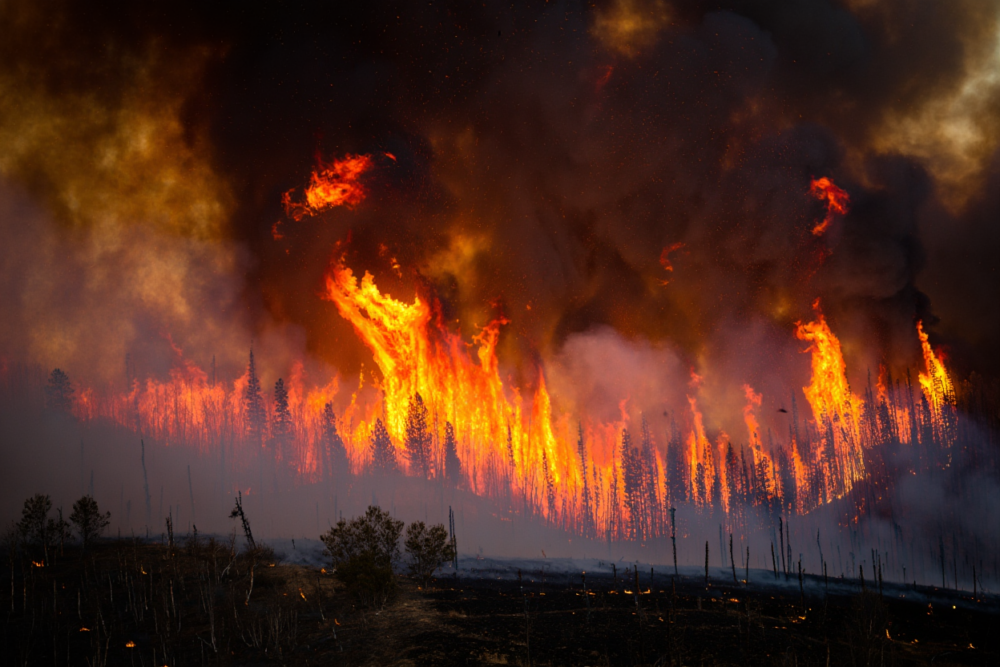
When it comes to wildfires, Pennsylvania trails behind most U.S. states in terms of number of fires and number of acres burned. However, wildfires in the Coal State are still a common occurrence. In fact, they happen like clockwork during certain periods of the year.
The Department of Conservation and Natural Resources (DCNR) has identified two main seasons wherein there is a surge in wildfire occurrences across the state. “The greatest danger of wildfires in Pennsylvania occurs during the spring months of March, April, and May, and the autumn months of October and November,” the DCNR states.
Why spring and autumn? Well, both seasons meet the conditions necessary for a wildfire to occur: dry conditions, a fuel source, and an ignition source.
- PA Wildfires in the Spring
Spring days in Pennsylvania are long and warm. With trees having yet to put on their verdant crowns, the sunlight that touches the forest floor not only warms the ground, it also dries any surface fuel, i.e., leaves, dead branches, pine needles, etc., lying around. Even in the fields, grasses still have their brown tops from the previous year.
Though there may be spring showers, they are only able to moisten the ground, not the dead leaves, twigs, and other fuel sources on top of the soil. In other words, while the ground might be wet, the remnants of the trees’ foliage and other dead vegetation are most likely very dry.
This checks off two items on the must-have list for wildfires to start: dry conditions and fuel source. All that’s missing now is an ignition source (more on this below).
- PA Wildfires in Autumn
The autumn season is not very different from the spring in terms of dryness and the abundant supply of fuel source. As trees shed off their foliage, these discarded leaves accumulate on the ground below.
This reduced canopy cover allows more sunlight to reach the pile of leaves, drying them out and making them a fire hazard. Like springtime, autumn days bring strong, dry winds that exacerbate the abundance of fuel sources during the period.
What is the Leading Cause of Wildfires in Pennsylvania?
The third condition necessary for a wildfire to happen is the ignition source, and in Pennsylvania, the start of a fire can be almost always traced back to people. The Department of Conservation and Natural Resources (DCNR) fixes the rate at which humans cause wildfires in the state at 99%.
To be precise, it is a particular human activity that is most commonly the culprit of wildfires in Pennsylvania, and that is debris burning. It only takes a tiny spark to ignite very dry grass, for instance, especially when they are aided by breezy conditions to hit their mark. Once ignited, the same strong winds spread the wildfire across a vast area, turning it into a major problem.
“A careless person burning trash or yard waste can be responsible for causing wildfires that burn thousands of acres of valuable Pennsylvania forests,” the DCNR said. “These fires most frequently start in someone’s backyard and travel through dead grass and leaves into bordering woodlands.”
Other causes of wildfires still consist of human activities, including equipment use, campfires, and power lines.
Case Study: Michaux State Forest Fires (2025)
A recent example of wildfires being caused by humans are the two wildfires that burned through the Michaux State Forest in April 2025. Officials from the Department of Conservation and Natural Resources (DCNR) confirmed that both were human-caused.
The Thompson Hollow Fire and the Hammonds Rocks Fire, as the Pennsylvania Bureau of Forestry called them, burned through a combined total of more than 2,500 acres (over 1,000 hectares) of woodland in a span of two weeks. The Hammonds Rocks Fire blazed through 470 acres (around 190 hectares), while the Thompson Hollow Fire consumed 2,248 acres (nearly 910 hectares), making it one of the largest in the state.
These two wildfires are just two examples of the more than 1,500 wildfires reported in the state in 2025, according to the DCNR. The year 2025 marked the fifth straight year that Pennsylvania’s wildfire count went beyond 1,000. The wildfires went through more than 3,000 acres (over 1,200 hectares) and caused 14 injuries, two deaths, and 37 destroyed structures.
In 2024, the Quaker State recorded 1,448 wildfires, which burned through more than 3,792 acres (over 1,500 hectares). Meanwhile, in 2023, nearly 1,901 wildfires burned through 9,186 acres (around 3,700 hectares) in the state.
Role of the Wildland-Urban Interface in PA Wildfires
The U.S. Fire Administration (USFA) defines the wildland-urban interface (WUI) as “the zone of transition between unoccupied land and human development. It is the line, area or zone where structures and other human development meet or intermingle with undeveloped wildland or vegetative fuels.”
As of 2021, the National Association of State Foresters (NASF) recorded more than 60,000 communities in the country that are at risk for WUI fires. Based on data, there was an average of more than 3,000 structures lost to WUI fires annually from 2002 to 2016, and that number is only expected to keep on growing. According to expert estimates, the WUI area will continue to increase by around 2 million acres per year, which means more and more communities will be at risk of WUI fires.
This risk is already significant in Pennsylvania which ranks fifth when it comes to having the greatest number of houses in the WUI, after California, Texas, Florida, and North Carolina. According to data from the U.S. Forest Service, the Keystone State’s houses in the WUI are in the 30.1% to 45% range.
A separate report shares that more than 50% of homes have been built in WUIs across dozens of counties in the state and that this is becoming an increasingly common practice.
“Wildfires pose a dangerous and growing threat to our state’s forests and the surrounding communities that live and recreate near these woodlands,” DCNR Secretary Cindy Adams Dunn told PennWatch.
Understanding how common wildfires are in PA can help residents, property owners, and businesses better prepare for potential fire threats.