
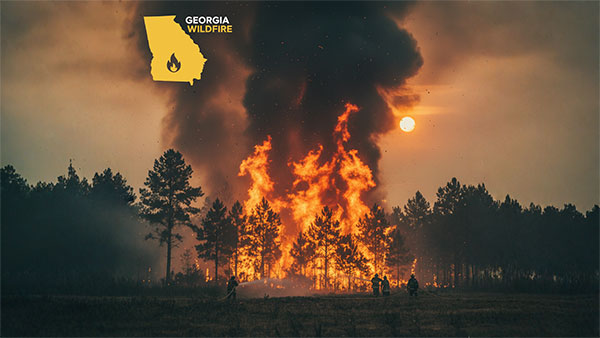
Georgia’s wildfire history reads like a chronicle of destruction. Over the past century, the Peach State has battled blazes that consumed hundreds of thousands of acres, impacted entire communities, and reshaped how we think about forest management. These aren’t just statistics in a government report; they’re events that cost taxpayers millions, displaced families for months, and changed Georgia’s landscape.
According to the Georgia Forestry Commission, wildfires burn an average of 2,300 acres (around 930 hectares) annually across the state. When you factor in property damage, lost timber revenue, and long-term ecological restoration, even “routine” fire seasons can drain state resources by the millions.
That is why understanding Georgia’s fire-prone past is essential preparation for protecting your property, community, and investment in this beautiful but combustible state. To help you do that, here are some of the most notable wildfires in Geogia’s history.
The Great Okefenokee Swamp Fires of 1954-1955
The Okefenokee Swamp, located in the southeastern part of the state, is notorious for wildfires. A major reason for the frequent wildfires is the abundance of peat in the area. Peat is mostly made up of dead plant matter that hasn’t fully decomposed.
The largest swamp in North America is, in fact, accustomed to massive fires that it might feel like history repeats itself so often every several years or so. For instance, the swamp was engulfed in wildfires in 1844, 1860, 1910, 1932, 1954, 1955, 2007, and 2011.
The granddaddy of Georgia wildfires started small and became a monster. Between July 1954 and June 1955, an extended drought resulted in five major fires. What locals initially dismissed as another swamp fire eventually consumed about 350,000 acres (around 142,000 hectares) across the Okefenokee National Wildlife Refuge, plus 150,000 acres (about 60,000 hectares) of adjoining timber.
When the swamp’s water level is low, the vast peat bog essentially becomes a tinder box. “The vegetation is exposed and dries out,” then swamp guide Clay Purvis told The New York Times back in 1977, “and then you get lightning or a campfire and it’s ignited. If the peat is dry enough, it will start to burn, just inch along, and you can’t put it out. It might burn down 10 feet; you won’t see any flame, then it will shoot up in a grove of trees.”
At least one fire lasted for days, and another for five months. The causes were varied, including lightning, arson, and accidents. In the end, this 1950s series of fires left a blackened and unrecognizable swamp strewn with some dead wildlife.
Bugaboo Scrub Fire (2007)
The Bugaboo Scrub Fire, which is considered to be the largest wildfire in Georgia’s history, was actually the merging of two separate fires. The first one occurred on April 16, 2007 due to a downed power line in the Sweat Farm Road, while the second one happened on May 5 when two lightning strikes hit Bugaboo Island in the Okefenokee Swamp. The fires were facilitated by drought conditions and sustained by 40 smaller fires caused by arson and burning.
The fire also affected Florida and is also considered to be one of the largest wildfires in the history of the Sunshine State. Thick smoke reached the state’s busy interstate highways, I-10 and I-75, which resulted in their brief closure.
It took firefighters until late June 2007 to finally contain the fire. Although nine homes were destroyed, fortunately no people were harmed by the massive fire. However, the Bugaboo Scrub Fire swept through more than 500,000 acres (over 200,000 hectares) across the two states. Considered to be the “worst wildfires in Georgia since the 1950s,” it resulted in commercial timber losses of at least $30 million. Along with firefighting and reforesting costs, this cost shoots up to over $80 million.
Honey Prairie Fire (2011)
In 2011, lightning started a fire in the southwest corner of the Okefenokee Swamp, which burned through more than 300,000 acres, including 18,206 acres (around 7,000 hectares) of private land, according to The Florida Time-Union. Known as the Honey Prairie Fire, it was finally declared out less than two weeks before its anniversary.
The fire resulted in timber losses, the destruction of the boardwalk on Chesser Island, and damage to an observation tower.
St. Catherines Island Fire (2022)
The year 2022 saw one of the country’s worst wildfire seasons, with over 30,000 events burning around 4,600 square miles (nearly 12,000 square km). One of these was the wildfire at St. Catherines Island, an ecologically and historically rich site.
A lightning storm on June 11 was the culprit, fanned on by severe drought. The resulting fires torched 6,700 acres (2,700 hectares), and columns of black smoke was visible to people in the mainland.
St. Catherines Island was the residence of a signer of the Declaration of Independence, Button Gwinnett. It is also home to giant sea turtles and ring-tailed lemurs as well as to the remnants of a 16th-century Spanish mission, plantation ruins, and archaeological sites.
Georgia West Mims Fire (2017)
On April 6, 2017, a wildfire erupted 2.5 miles northeast of the Eddy Fire Tower in the Okefenokee National Wildlife Refuge. It promptly spread across the refuge and eventually made its way into private land about a month later. In total, the Georgia West Mims Fires burned through more than 140,000 acres (nearly 56,000 hectares).
What’s interesting about this wildfire event is the sighting of a smokenado, or a tornado made of smoke. Colorado-based firefighters West Metro Fire and Rescue shared on X (formerly Twitter), “Our crew at the #WestMimsFire in Georgia is seeing smokenadoes. Or, more accurately – smoke whirls.”
The Georgia West Mims Fire was finally declared out by July.
Learning from Georgia’s History of Flames
Georgia’s wildfire chronology reveals clear patterns that property owners and communities ignore at their peril. Each major fire shares common elements, such as extended drought and high winds. The good news? We’ve learned how to fight fires more effectively. The concerning news? Development continues to push into high-risk areas without adequate fire protection measures.
Bottom line: Georgia’s wildfire history isn’t just about the past; it’s a roadmap for protecting your future. Invest in defensible space around your property, support local fire departments, and stay informed about fire weather conditions. Because if history teaches us anything, it’s that the next big fire isn’t a matter of if, but when.